by Lorena Cano | Oct 2, 2026 | Uncategorized
Home prices are one of the most visible parts of the housing market, but the number attached to a property does not tell the entire story. Buyers and sellers can benefit from looking at the factors that influence pricing and understanding how local conditions affect property values.
A home’s price can be influenced by location, property condition, size, recent comparable sales, available inventory, buyer demand, and broader economic conditions. These factors can change over time, which is why a property’s value should be considered within its current market context.
Location Can Influence Value
Location remains an important part of residential real estate pricing. Access to transportation, local services, employment centers, parks, shopping areas, and other community amenities can affect how properties are valued.
However, location is only one part of the picture. Two properties in the same general area can have different values because of their size, condition, layout, updates, lot characteristics, and other property-specific factors.
Inventory Can Affect Pricing
The amount of available housing can influence market conditions. When fewer properties are available, buyers may have fewer choices. When inventory increases, buyers may have more opportunities to compare properties and negotiate.
Inventory can also vary by price range and property type. Looking at overall market statistics without considering these differences may provide an incomplete picture.
Comparable Sales Provide Useful Context
Recent comparable sales can help establish a clearer picture of what buyers have actually paid for similar properties. Comparable properties are typically evaluated based on factors such as location, size, condition, features, and timing.
Because no two homes are exactly alike, comparable sales should be considered alongside property-specific characteristics rather than treated as a simple formula.
Market Conditions Can Change
Home prices can move differently from one market to another. National trends may provide useful background, but local supply, demand, economic activity, and housing characteristics can produce different results.
This is why homeowners considering a sale or buyers evaluating a purchase may benefit from looking at current local data rather than relying only on national headlines.
Look at the Complete Housing Picture
Understanding home prices requires more than checking a listing price or a national median. Buyers and sellers can benefit from considering recent sales, inventory, property condition, financing costs, and local market activity together.
A clear understanding of these factors can make it easier to evaluate a property’s asking price and understand how current market conditions may affect a real estate decision.

by Lorena Cano | May 27, 2025 | Home Prices
Image by Canva
Let’s face it—most of us don’t spend a ton of time thinking about tariffs. They sound like something better left to economists and politicians, right? But if you’re planning to buy, sell, or build a home, tariffs—especially those like the ones imposed during the Trump administration—can quietly affect the price tags you’re seeing on properties. So, what’s the connection between international trade policy and the value of your dream home? Let’s break it down.
First, a quick refresher: a tariff is essentially a tax on goods brought in from other countries. The idea is to make imported products more expensive, which can encourage people to buy from domestic manufacturers. Sounds simple enough. But in reality, those increased costs don’t just disappear—they get passed down the line. When tariffs are placed on materials like steel, aluminum, lumber, appliances, or cabinetry, the cost of building or upgrading a home starts creeping up.
This hits home builders especially hard. If it costs more to build a house, developers may delay or scale back new construction projects, which affects the inventory of available homes. Fewer homes on the market, combined with steady or growing buyer demand, often results in—you guessed it—higher home prices. Even small increases in material costs can significantly impact overall construction budgets, which trickles down to consumers.
Let’s say a builder planned to construct a dozen homes in a neighborhood, but the cost of imported lumber and stainless steel suddenly jumps by 15%. They now have to decide: do they eat that cost? Probably not. More likely, they’ll either raise the prices of the homes, reduce the number of builds, or substitute with cheaper materials—which can affect quality and long-term value.
But it’s not just new construction that’s impacted. Home renovations can also get more expensive. Think about homeowners who want to do a kitchen remodel or add a bathroom before selling. If those shiny imported fixtures or materials now cost more because of tariffs, sellers may need to increase their asking price to make it worthwhile—or skip the upgrade altogether, which can affect how quickly a home sells and for how much.
Even if you’re buying an existing home and not planning any immediate upgrades, tariffs can still indirectly influence your buying power. Higher home prices, whether from new builds or increased competition in the resale market, can stretch your budget further than you expected. And if inventory drops due to slowed construction, that limited supply can push prices even higher.
Now, all of this doesn’t mean that tariffs will automatically crash or spike the housing market overnight. The actual impact depends on a lot of moving parts—like interest rates, local inventory, buyer demand, and broader economic trends. But it *does* mean that real estate doesn’t exist in a bubble. Trade policy might seem like faraway political talk, but it can have a very real effect on your wallet.
So if you’re thinking of buying, selling, or building soon, keep an eye on what’s happening globally. The market responds to more than just local listings—sometimes, it’s responding to what’s happening at ports and borders, too.
by Lorena Cano | Mar 10, 2025 | For Buyers, For Sellers, Home Prices
Recent headlines have been buzzing about the median asking price of homes dropping compared to last year, and that’s sparked plenty of confusion. And as a buyer or seller, it’s easy to assume that means prices are coming down. But here’s the catch: those numbers don’t tell the full story.
Nationally, home values are actually rising, even if the median price is down a bit. Let’s break down what’s really happening so you can make sense of the market without getting caught up in the fear the headlines create.
Homes on the Market Right Now Are Smaller
The biggest reason for the dip in median price is the size of homes being sold. The median price reflects the middle point of all the homes for sale at any given time. And that’ll be affected by the mix of homes on the market.
To show you how this works, here’s a simple explanation of a median (see visual below). Let’s say you have three coins in your pocket, and you decide to line them up according to their value from low to high. If you have one nickel and two dimes, the median (the middle one) is 10 cents. If you have two nickels and one dime, the median is now five cents.
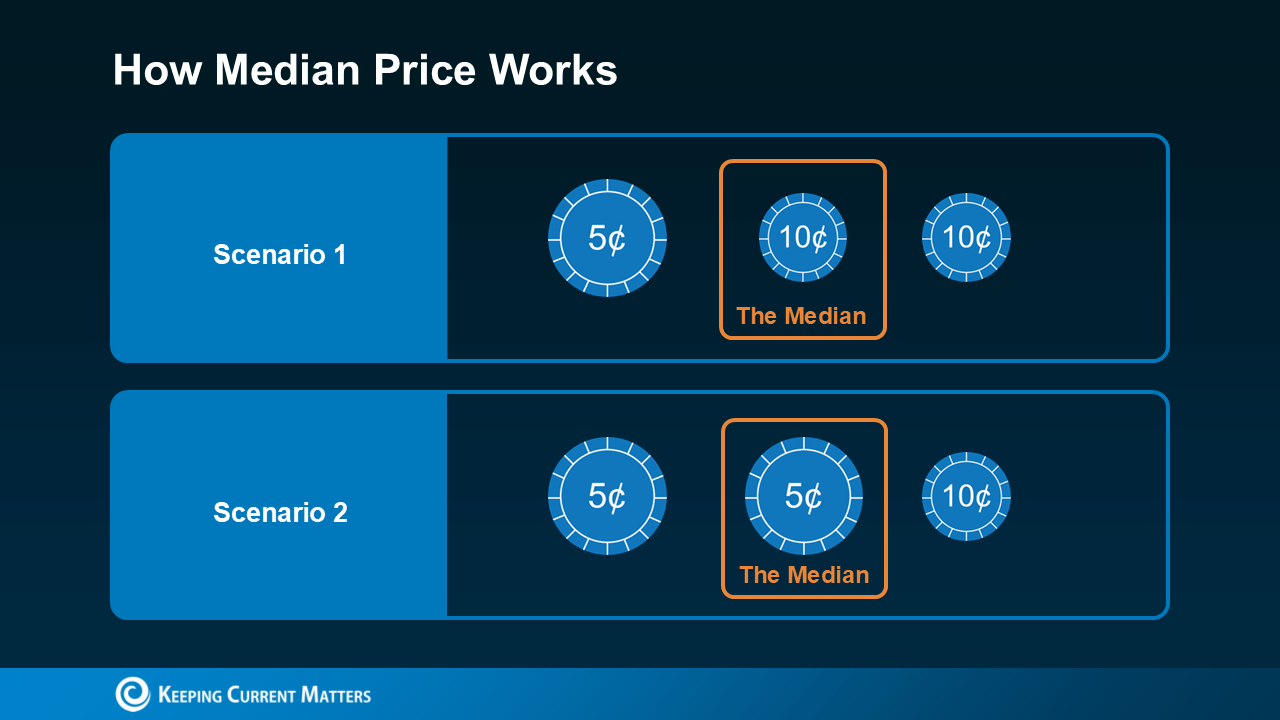 In both cases, a nickel is still worth five cents and a dime is still worth 10 cents. The value of each coin didn’t change. The same is true for housing.
Right now, there’s a greater number of smaller, less expensive homes on the market, and that’s bringing the overall median price down. But that doesn’t mean home values are declining.
As Danielle Hale, Chief Economist at Realtor.com, explains:
“The share of inventory of smaller and more affordable homes has grown, which helps hold down the median price even as per-square-foot prices grow further.”
And here’s the data to prove it.
Price Per Square Foot Is Still Rising
One of the best ways to measure home values is by looking at the price per square foot. That’s because it shows how much you’re paying for the space inside the home.
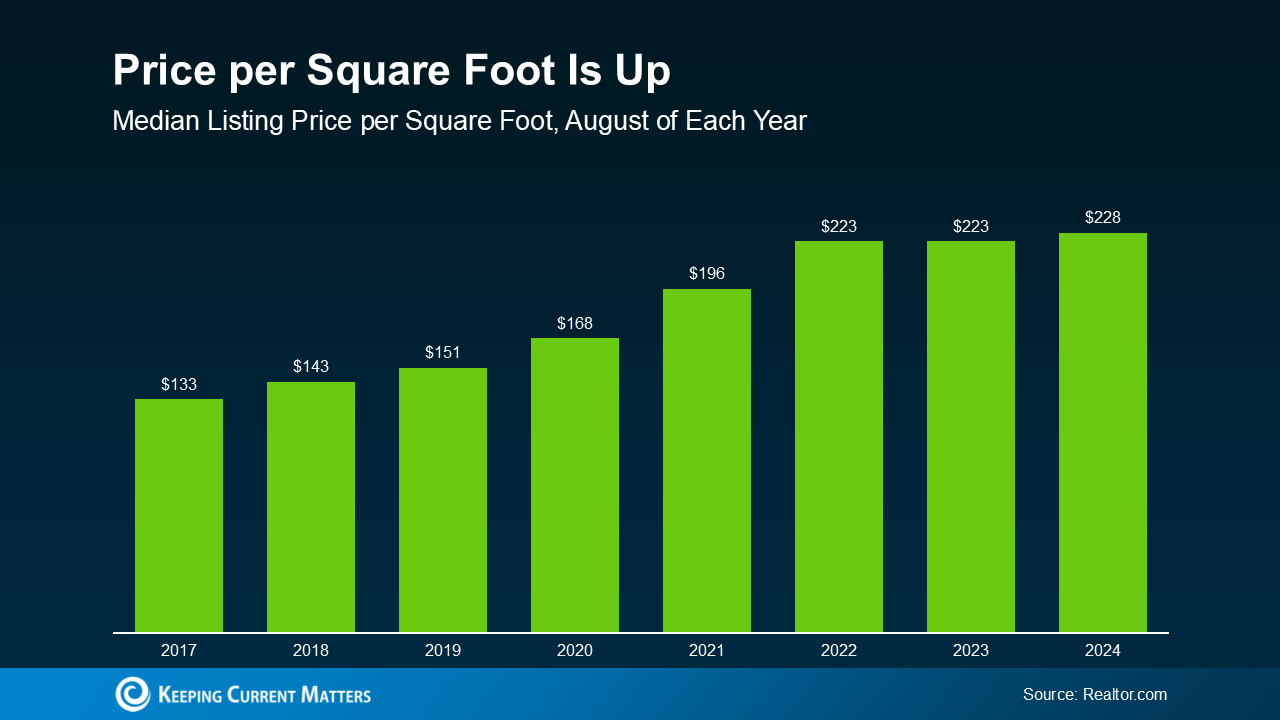
The median asking price doesn’t take into account the size of different homes, so it may not always reflect the true value. And the latest national price per square foot data shows home values are still increasing, even though the median asking price has dropped (see graph below).
 As Ralph McLaughlin, Senior Economist at Realtor.com, explains:
“When a change in the mix of inventory toward smaller homes is accounted for, the typical home listed this year has increased in asking price compared with last year.”
This means that while smaller homes are affecting the median price, the average home’s value is still rising. According to the Federal Housing Finance Agency (FHFA):
“Nationally, the U.S. housing market has experienced positive annual appreciation each quarter since the start of 2012.”
So, while headlines may make it sound like prices are crashing, you don’t have to worry. With a closer look and more reliable data, you can see that prices are still climbing nationally.
But it’s important to remember that home prices can vary by region. While national trends provide a big-picture view, local markets may be experiencing different conditions. A trusted agent is the best resource to explain what’s happening in your area.
Bottom Line
The decrease in median price is not the same as a decrease in home values. The median asking price is down mostly due to the mix of smaller, less expensive homes on the market.
The important thing to focus on is the price per square foot, which is a better indicator of overall market value—and those prices are still going up. If you have questions about what home prices are doing in your area, reach out to a local real estate agent who can provide insights on your specific market.